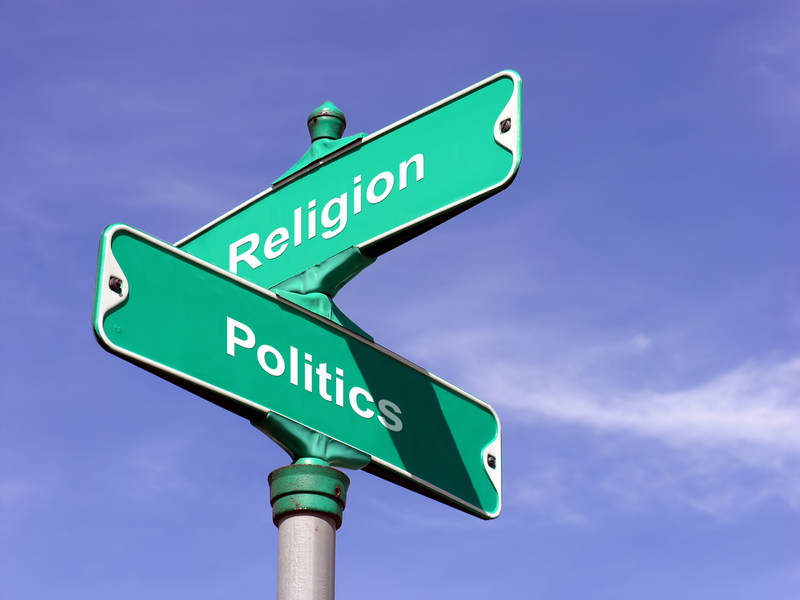
The first thing anyone can say (or should say) about contemporary politics is that most who adhere to a political party are who they are because their traditions have shifted the memes to their own cognitive bloodstreams. Mom and Dad were conservatives (or liberals or Democrats or Republicans), so it goes without saying that son and daughter carry the weight of the same unreflective belief system on their backs. This much should immediately loosen the emotional burden when trying to argue with people who disagree with us on political matters. Their points of view are even likely based in "unarguable" values which determine them. We should be wise in learning where the threshold lies.
What bothers me most, however, is how contemporary Republicanism has used ideas such as God and family values and all the emotive sensitivity that these labels carry with them as a way of militarizing against a created enemy that is perpetually intent on actualizing his evil scheme of turning America to moral ashes if ever the Democrats and "liberals" steal the day. If we had no greater reference for Christian spirituality in America than the campfire meetings of Republican ideology, we would walk away with the belief that God is for money (even the love of money), war and all the millions of innocent deaths that go along with it for a likely avoidable end, and that he rewards only those who pull themselves up by their bootstraps and break from the crowd to achieve all the greatness that is demanded of them all by themselves, without inspiration or help from others.
This is all ironic to the point of comedy, because I think that if you look at the matter close enough, you'll see that the vast majority of what Republicanism has come to stand for -- and with it the vast majority of self-titled "conservatives" -- is as far from the spirit of Christ as possible. Thankfully, though, most people self-identify with it because (as said above) tradition has provided them with an unreflective emotional attachment to it. As an aside, I only choose Republicanism because of what I deem the mammoth contradiction of values essential to it. All political ideologies run the risk of danger if for no other reason than because they can easily make a secular paradise take the place of a spiritual one. Democratic values (or for that matter conservative, liberal, libertarian, socialist, Marxist, etc.) are not exempt from their own weaknesses, and I make it an honor not to affiliate with any party in American politics.
Let's be honest with ourselves by admitting this much to begin with: God is not a capitalist. The most superficial of skimmed readings of the Gospel makes it clear that Christ has nothing but wariness and disdain towards a spirit which values material wealth:
He has brought down rulers from their thrones, and has exalted those who were humble. He has filled the hungry with good things; and sent away the rich empty-handed. -- Luke 1:52-53
But woe to you who are rich, for you are receiving your comfort in full. -- Luke 6:24
Again I say to you, it is easier for a camel to go through the eye of a needle, than for a rich man to enter the kingdom of God. -- Matthew 19:24
Beware, and be on your guard against every form of greed; for not even when one has an abundance does his life consist of his possessions. And He told them a parable, saying, "The land of a rich man was very productive. And he began reasoning to himself, saying, 'What shall I do, since I have no place to store my crops?' Then he said, 'This is what I will do: I will tear down my barns and build larger ones, and there I will store all my grain and my goods. And I will say to my soul, 'Soul, you have many goods laid up for many years to come; take your ease, eat, drink and be merry.' But God said to him, 'You fool! This very night your soul is required of you; and now who will own what you have prepared?' So is the man who stores up treasure for himself, and is not rich toward God. -- Luke 12:15-21
And all those who had believed were together and had all things in common; and they began selling their property and possessions and were sharing them with all, as anyone might have need. -- Acts 2:44-45
No one can serve two masters; for either he will hate the one and love the other, or he will be devoted to one and despise the other You cannot serve God and wealth. -- Matthew 6:24
This should be more than enough to convince us that God is not for any political ideology that advocates the accumulation of wealth as valuable in itself, that is pervaded through and through with the most basic forms of capitalism, that posits self-interest as a motivator for profit. The last verse is enough to cause considerable quivering from a pro-business fanatic, as it should. I don't think (although some would clearly disagree) that these verses mean that God is advocating socialism. I have little but laughter for anyone who would read such a specific economic doctrine into the words of the Bible, considering that both socialism and capitalism are hundreds and hundreds of years in the future in relation to the writing of the New Testament. The meaning is unambiguously clear, however, that the selfishness that a pursuit of happiness along materialistic lines blooms is antithetical to everything that God and love (or God and therefore love) are for.
Further, some would be hermeneutically naive enough to interpret the passage where Jesus asks the rich young ruler to sell all his possession and follow him (Luke 16:22) and apply this to everyone at all times. This much is obvious from other passages. Example:
Zaccheus stopped and said to the Lord, "Behold, Lord, half of my possessions I will give to the poor, and if I have defrauded anyone of anything, I will give back four times as much." And Jesus said to him, "Today salvation has come to this house, because he, too, is a son of Abraham. -- Luke 19:8-9
So is it all of my possessions through appealing to the story of the rich young ruler, or half of my possessions through appealing to Zaccheus? If half by Zaccheus is sufficient, why not a fourth by others, or an eighth, and so on? The point of emphasis seems to be that the rich man loved God in everything except wealth, which he loved so dearly that only a violent break with it could pull his heart fully towards God. His mistake was what C.S. Lewis warned about: we are trying to "remain what we call 'ourselves,' to keep personal happiness as our great aim in life, and yet at the same time be 'good'.... And that is exactly what Christ warned us you could not do." This little bit of "ourselves" is relative to each individual; each self has, as it were, its own idol to starve to death through one's abandonment of it through finding shelter in the presence of God. With the rich man it was clearly wealth. With others it could be lust, or food, or looking the flashy in the eyes of others.
But for our political subject, it is clearly the case that wealth is an easier and more dangerous temptation than other inclinations to sin. It seems, especially upon surveying the sample of verses above, that wealth is one of the popular subjects of Jesus, and it's not hard to see why. Wealth allows both the possibility for security and power. When I have money, I can very easily believe that because all my earthly cares are provided for, there's nothing else to worry about, unconsciously yielding to the consolation that I "have many goods laid up for many years to come; take your ease, eat, drink and be merry," not apprehending that my very soul is murdered while I speak these words (Luke 12:19-20). Power can be defined as the capacity to influence one's world for the sake of one's preferred ends. Precisely because money allows us to buy all the things we crave, including what we falsely believe to be absolute security, others are easily under its influence. Indeed, in advanced capitalist societies like ours where there is a large gap between rich and poor, the rich often are the kings over individuals who fill the servant role in proportion to how little they have. Money has purchased assassinations of presidents because they didn't fit the goals or values of those who made the payment. It corrupts our politics because the immediate monetary gift offered by the lobbyist is so much more seductive to the politician than the cold abstractions of justice for the people. Verily, love of wealth has instrumentalized the whole world for the sake of the wishes of its lovers.
I can hear the bowtied critic now: "Well, you're against love of wealth, not capitalism. There are thousands of honest business men and women who work to make a living without loving money." This is most certainly true, but what I'm focusing on is capitalism as a central ethos for American society, as something that every "good American" strives to fulfill. It's seductively easy to go from adhering to a doctrine which values private property to valuing private property as a form of security or power that shifts God out of the way in place of idolatry. Many don't do this, yes, precisely because they love God more than anything, and when you love God it is impossible to be so foolish as to value anything as a source of security or happiness, but I'll be wary of anyone who claims that it isn't incredibly hard to keep the monster of wealth at bay.
Of course, when I pose this longwinded theological rabbit trail I'm not saying that things can't have a place in our lives, and even be enjoyed by us. They most certainly can. After all, the universe was created for a reason. It's when we put the emphasis on matter as ours that things become problematic. It's much better to see everything as it is: the creation of God. This much can be so very helpful in balancing the greed that so often attends the quest for private property. And we shouldn't stop at the world out there, but include our bodies with the deal. Hence Neruda could say in his ravishing poem, "October Sky":
Little by little, and also in great leaps,life happened to me,and how insignificant this business is.These veins carriedmy blood, which I scarcely ever saw,I breathed the air of so many placeswithout keeping a sample of any.In the end, everyone is aware of this:nobody keeps any of what he has,and life is only a borrowing of bones.
I'm fond of imagining an alternate ending to the story of the rich young ruler. Upon being told by Jesus to sell his possessions and follow him, after a time of painful contemplation the man looks up and says "very well". The moment the last object in his life is gone, every piece of furniture moved from his house, every expensive ornament sold from his body, his heart becomes full with a preternatural joy that he's never experienced before. After days in solitude with prayer and appreciation before God for finally achieving that small stretch of liberty he could never seem to have despite his previous love of God before giving up his possessions, he finds Jesus again preaching on the streets. He walks to his face, half-squinting in the scathing Middle Eastern sun, and after releasing a sigh and a smile tells him "everything is perfect! I finally understand!" Whereupon Jesus responds without skipping a beat, "Good. You may have your possessions back again, for you finally see with untrammeled perception."
The problem with love of wealth is that it snuffs God out as the firm security for our lives, and the very life of every truly spiritual person should be centered on absolute dependence upon God. What does it mean to love something more than God? A good test is to ask yourself if you can really live as happy an existence without it. The modified question of Jesus can apply hypothetically to ourselves: "When I sent you out without iPod or Mustang or kitchen collection or professional reputation, you did not lack anything, did you?" If you can answer with the disciples, "no, nothing" (Luke 22:35), then your heart is fully right with God, and you can see the mad scraping for material goods towards the goal of an invisible kingdom of self for the silliness that it truly is.

No comments:
Post a Comment