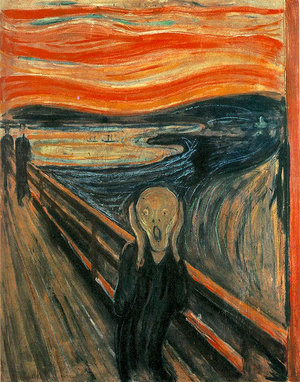
I think I finally know what distinguishes the carelessness of youth from the bedraggled, beat up, deadpan semilife that starts perchance in the twenties, blooms in the forties, chokes in the sixties, and kills shortly thereafter. It's not anxiety (good guess), not despair (ah, too romantic), not even stress (not precisely).
It's worry. Youth represents carelessness, lightness, freedom of mind; old age, which deposits its seed before the hairline rises, represents worry, fear, despair. Groucho Schopenhaur had it all wrong (as he usually does, but in truth-revealing ways): "At every step, in great things and small, we are bound to experience that the world and life are certainly not arranged for the purpose of maintaining a happy existence...hence the countenances of almost all elderly persons wear the expression of what is called disappointment." Au contraire, my poodle loving pessimist. There is plenty in life to be happy about, as with the reverse. It's not disappointment that paints the faces of the old, but the faintly lingering touch of exhaustion which no mere life of physical drudgery can form. And the greatest contributor to this exhaustion is worry, for worry is mental murder, an unassailable overcare for the future and all the valleys it contains.
To slightly alter the words of unappreciated existential psychoanalyst Leslie Farber, worry is the act of willing what can't be willed. As such it's close to obsession, but even obsession has a little fun with it. Worry, however, conjures up being worn out by something or someone who is transferred to an abstraction that pummels our minds. This is different from anxiety (although the two are sometimes used synonymously, often with one entailing the other), and it's actually anxiety that Farber uses in the paraphrase above, which I've changed. Anxiety, at its very basic level, is healthy; Kierkegaard calls it "the dizziness of freedom," and as such it signifies that I'm on the verge of making a choice, becoming a self, really existing, all of which has its reward -- namely, the euphoria of truly being alive. But when I worry my whole being is frozen up in idleness, save for that constantly repeating inward attention I have for something that concerns my future and births my desire. I can do nothing but think of it, whatever thing I would substitute for the pronoun, and this thinking is a prison. It's psychologically and emotionally exhausting, suffocating in the slowest, most torturous way.
Do you worry? The theological rage is to quote Jesus out of context:
And worrying is on the rise. To quote from Farber: "with the disappearance of the divine Will from our lives, we have come to hunger not for His Will -- neither in the sense of living in His Will nor usurping His Will for ourselves -- but rather for our own sovereign will, which is our modern way, this side of omnipotence of suicide or madness. And all exhortations notwithstanding, this will we cannot will." Ours is the beginning of the second century of what Nietzsche called the death of God, where religion is disappearing from culture, with the converse rise of technological and scientific idols. This has obvious results: nihilism, the twentieth century as the bloodiest in human history, and (relevant to our discussion) the surging up of worry as a popular torment because God, who previously bore our burdens, is becoming less and less of a sanctuary for us. This disappearance of the divine Will which Farber speaks of isn't limited to atheism. Within the confines of orthodox Christendom, the false secular solution is becoming popular when trials burden us: rather than the prophylactic of prayer and dialogue with God, we try alternate methods. We vegetate in front of the television, or lose ourselves online, or let alcohol ameliorate our wounds, or seek out transient salvation in the lives of others. Our century is one where our troubles are never quite bad enough to force us into prayer, and this loss of deep suffering is the worst suffering of all.
For this reason I say to you, do not be worried about your life, as to what you will eat or what you will drink; nor for your body, as to what you will put on. Is not life more than food, and the body more than clothing? Look at the birds of the air, that they do not sow, nor reap nor gather into barns, and yet your heavenly Father feeds them. Are you not worth much more than they? And who of you by being worried can add a single hour to his life? And why are you worried about clothing? Observe how the lilies of the field grow; they do not toil nor do they spin, yet I say to you that not even Solomon in all his glory clothed himself like one of these. But if God so clothes the grass of the field, which is alive today and tomorrow is thrown into the furnace, will He not much more clothe you? You of little faith! Do not worry then, saying, 'What will we eat?' or 'What will we drink?' or 'What will we wear for clothing?' For the Gentiles eagerly seek all these things; for your heavenly Father knows that you need all these things. -- Matthew 6:25-32 (NASB)We typically stop here, or some point arbitrarily prior. The mutilated implication is that Jesus is commanding us to cut off our worries by fiat. It's a very American way of twisting the intention of Jesus through omission, and fits our Randian mythos of the self-dependent rugged individualist, with whom the will is everything and every angle of reality is a mere coughing servant waiting to be commanded. Add the finishing verse: "But seek first His Kingdom and His righteousness, and all these things will be added to you." What a crippling heresy! To think that the commandments of God are possible without living our lives in Him. But that, alas, is the subject of another sermon. The moral here, though, is simple enough: seek the presence of God for the solution to your worries, and like all religious methods which work so marvelously, I'm almost sorry for those who would like a more profound solution. Is there really anything simpler for so bothersome a perennial problem?

2 comments:
Superballin' post, counselor.
I've been reading Thomas Kelly's sermons and it is pertinent to your last point:
"Donʼt grit your teeth and clench your fists and say, “I will! I
will!” Relax. Take hands off. Submit yourself to God. Learn
to live in the passive voice—a hard saying for Americans—
and let life be willed through you. For “I will” spells not
obedience."
Lorel
That was good...to say the least.
Post a Comment